


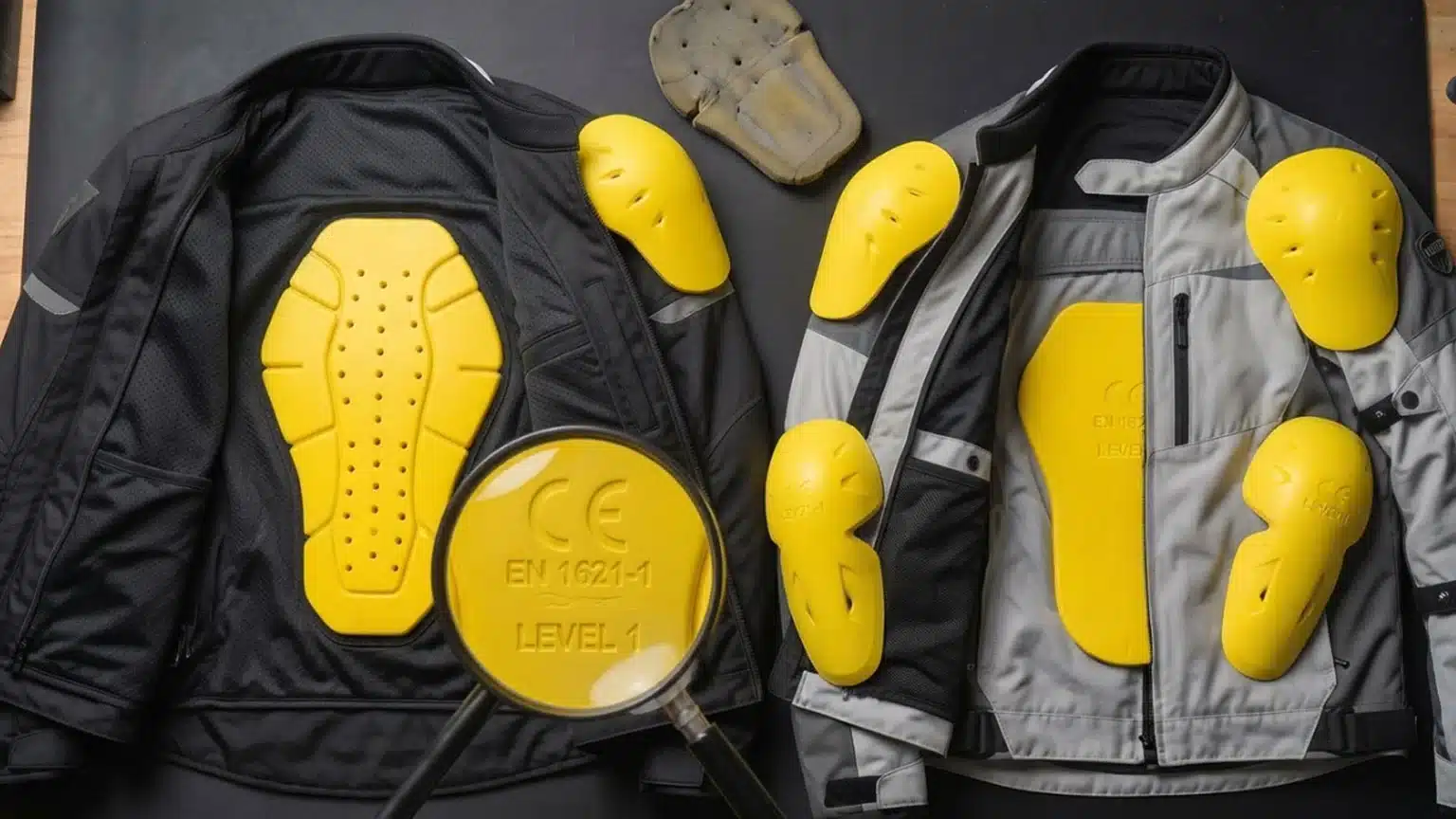
How CE Armor Levels Actually Work: AAA, AA, and A Explained
If you’ve shopped for a motorcycle jacket, you’ve seen the CE ratings — a jacket labeled “CE AA,” a shoulder pad marked “Level 2,” a back protector tagged “CE 1621-2.” Most product listings throw these labels around with little explanation, which leaves riders guessing whether a “Level 1” jacket is safer or less safe than an “AA” jacket. It’s a fair question, because those two labels are actually measuring two completely different things.
Quick Answer
CE (Conformité Européenne) certification for motorcycle gear comes in two separate systems that often get confused: garment ratings (AAA, AA, A) under standard EN 17092, which grade the whole jacket’s abrasion resistance and seam strength, and armor-piece ratings (Level 1, Level 2) under standards EN 1621-1 and EN 1621-2, which grade individual impact protectors like shoulder, elbow, and back armor. AAA is the highest overall garment rating, and Level 2 is the higher-protection armor rating. A jacket’s total protection depends on both — the garment class and the armor inside it.
Two Different Rating Systems, Not One Scale
This is the single biggest source of confusion, so it’s worth being direct about it: AAA/AA/A and Level 1/Level 2 are not the same scale. A jacket can be rated AA overall while containing Level 2 armor, or rated AAA while containing Level 1 armor. You need to check both if you want the full picture of a jacket’s protection.
Garment Ratings: AAA, AA, A (EN 17092)
This standard rates the jacket as a whole — its abrasion resistance, seam strength, and overall construction, based on where and how it’s meant to be used.
- AAA — the highest garment rating. Built for maximum abrasion resistance and typically used in race-oriented or high-performance touring gear, often full leather or heavy-duty textile with reinforced panels throughout.
- AA — strong, versatile protection for everyday and sport-touring riding. This is where most quality mid-to-premium motorcycle jackets land, balancing protection with comfort and mobility.
- A — a lower abrasion-resistance tier, generally found in urban, commuter, or warm-weather gear where full-coverage armor and heavy material would be impractical. Still tested and certified, just to a lower impact/abrasion threshold than AA or AAA.
Below A, you’ll also occasionally see Class B (abrasion-resistant but without impact armor — some riding jeans fall here) and Class C (armor-only garments, like base layers, with minimal abrasion resistance on their own). These aren’t relevant to most jacket shopping but are worth recognizing if you see them on a label.
Armor-Piece Ratings: Level 1 and Level 2 (EN 1621-1 and EN 1621-2)
This is a separate standard that rates individual protectors — shoulder, elbow, knee armor under EN 1621-1, and back protectors under EN 1621-2 — based on how much impact force they transmit to your body in a controlled test.
- Level 1 — passes the baseline impact test, transmitting a higher (but still tested and approved) amount of force through to the body.
- Level 2 — transmits roughly half the force of Level 1 armor in the same test, making it the higher-protection tier. Level 2 armor is often thinner than Level 1 despite performing better, thanks to improved foam and composite materials.
In practice: Level 2 armor is generally the better choice when available, and many riders treat it as the minimum they’ll accept for shoulder, elbow, and back protection, since it offers meaningfully better protection without much added bulk.
Why This Distinction Matters When You’re Shopping
A jacket’s marketing copy will often lead with the garment rating (“CE AA jacket!”) without mentioning what level the internal armor is — or vice versa. To actually evaluate a jacket’s protection, check for both:
- What’s the garment’s CE class (AAA/AA/A)? This tells you about the jacket’s overall abrasion resistance and build quality.
- What CE level is the armor inside it (Level 1 or 2)? This tells you how well the shoulder, elbow, and back protectors actually absorb an impact.
- Is a back protector included, or just a pocket for one? Many jackets include shoulder and elbow armor standard but only include a pocket for a back protector, which is sold separately. Don’t assume it’s included — check the spec sheet.
A jacket that’s AAA-rated but shipped with basic Level 1 armor is still a strong jacket, but you could likely upgrade the armor separately for meaningfully better impact protection without buying a new jacket.
Common Misconceptions
“CE-rated” alone doesn’t tell you much. Any jacket labeled CE-rated has passed some level of testing, but “CE-rated” without a class or level specified could mean anything from Class A to AAA, or Level 1 to Level 2. Always look for the specific rating, not just the CE label itself.
Higher garment class doesn’t automatically mean higher armor level, and vice versa. As covered above, these are independent systems. Check both.
Leather alone isn’t armor. Leather contributes to a jacket’s abrasion resistance (part of the garment-level AAA/AA/A rating), but it does nothing for impact protection on its own. Impact protection comes entirely from the armor inserts, rated separately under Level 1/Level 2.
What to Look for When Buying
For most street and sport-touring riders, a reasonable protection target is:
- Garment rating: AA or higher for regular riding; A is acceptable for short urban commutes in exchange for lighter, cooler gear.
- Shoulder and elbow armor: Level 2 where available.
- Back protector: Level 2, even if it means adding one separately — don’t skip this just because it wasn’t bundled with the jacket.
Frequently Asked Questions
What does CE AA mean on a motorcycle jacket? CE AA is a garment-level rating under EN 17092 indicating strong, versatile abrasion resistance suitable for everyday and sport-touring riding — one tier below the highest rating, AAA, and one tier above A.
Is Level 2 armor better than Level 1? Yes. Level 2 armor (under EN 1621-1 for limbs and EN 1621-2 for back protectors) transmits significantly less impact force to the body than Level 1 armor in standardized testing, making it the higher-protection option.
What’s the difference between CE AAA and CE Level 2? They’re different rating systems entirely. AAA is a garment-level rating (EN 17092) measuring the jacket’s overall abrasion resistance and construction. Level 2 is an armor-piece rating (EN 1621-1/EN 1621-2) measuring how well an individual shoulder, elbow, or back protector absorbs impact force. A jacket’s total protection depends on both ratings together.
Does every motorcycle jacket come with CE-rated armor? No. Some jackets include CE-rated armor standard, others include armor pockets but sell the armor separately, and some budget or fashion-oriented jackets include no armor at all. Always check the product specifications rather than assuming.
Can I upgrade the armor in my jacket later? In many cases, yes — jackets with standard-sized armor pockets can often be upgraded with higher-level (Level 2) aftermarket armor inserts, which is a straightforward way to improve protection without replacing the whole jacket.
Every ZARROE jacket lists its armor specifications on the product page — no guesswork required. Browse our motorcycle jacket collection or read our full fit guide to find the right protection level for how you ride.
 New Arrivals
 New Arrivals