


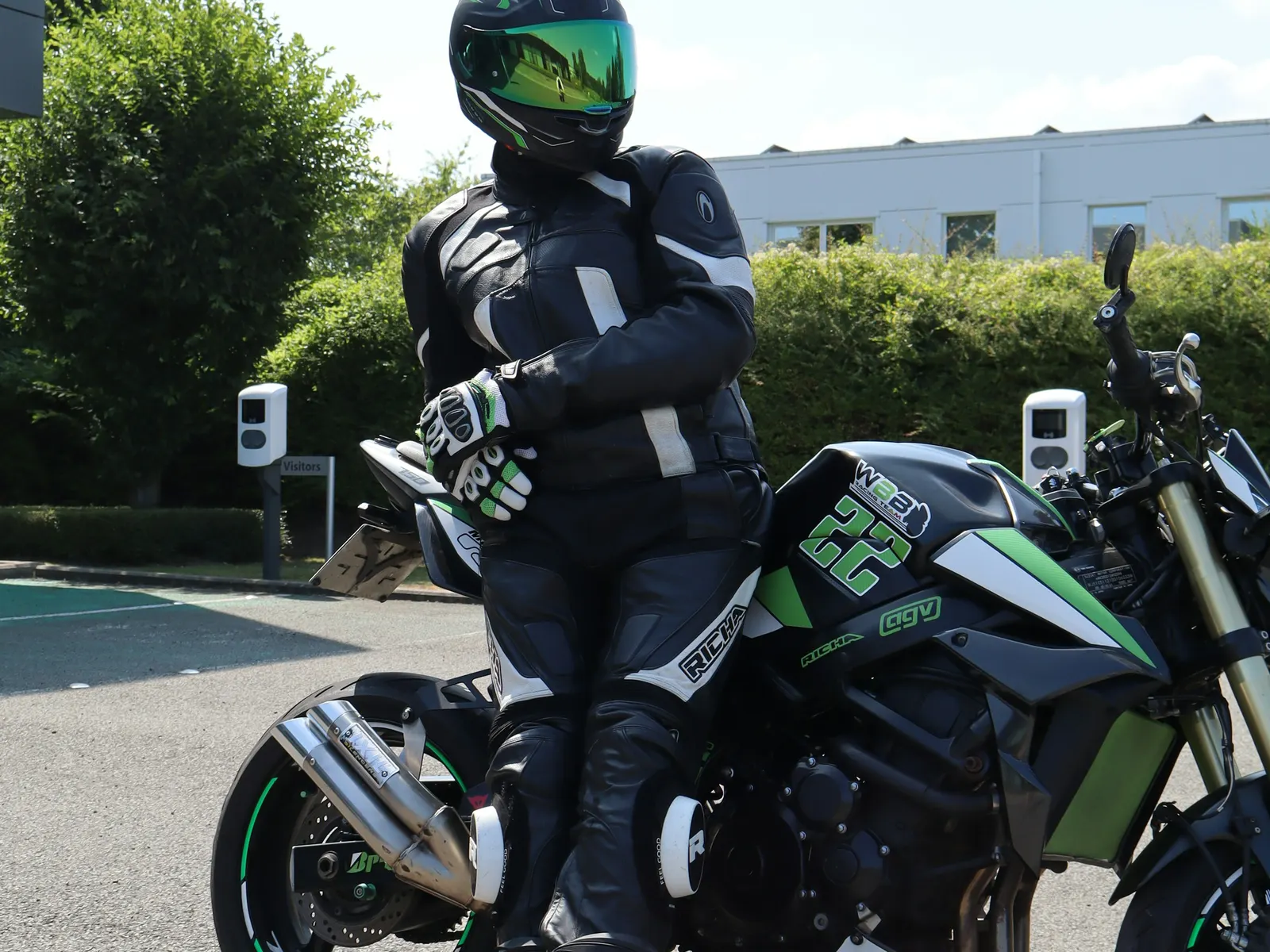
A motorcycle jacket ventilation system works best when air can enter through forward-facing intake vents, move through the garment, and leave through rear exhaust vents. Opening only the front vents may create pressure and ballooning without producing useful flow. Fit, liners, riding speed, and vent placement all affect the result.
Ventilation is not the same as protection, and a large number of zippers does not automatically mean a cooler jacket. The useful question is whether the jacket creates a controlled path for air while keeping its protective fit and closures secure.
Intake vents bring air into the jacket
Intake vents are normally placed where moving air reaches the rider: the chest, upper arms, forearms, or shoulders. Their position matters because a vent hidden behind a tall windscreen, backpack strap, or tightly fitted layer may receive very little airflow.
Chest vents can move air across the torso, while sleeve vents can direct it toward the arms and underarm area. A vent that can be held open is generally more useful than a zipper that creates only a narrow slit. Check that every zipper has a secure end position and that no pull or flap can strike the body at speed.
Exhaust vents give warm air a way out
Rear vents are not decorative extras. They provide an exit for the air entering at the front. Exhaust openings are commonly positioned across the upper back, shoulder blades, or rear sides of a jacket, where the lower-pressure area behind the rider can help draw air outward.
The MotoCAP technical guide to motorcycle protective clothing explains that controllable chest and back vents are effective cooling locations and that at least two openings are important for through-flow. It also warns that a front opening without an outlet can cause the garment to balloon.
A quick buying check is to open the front and rear vents, look inside the jacket, and trace the path between them. A waterproof liner, armor pocket, heavy insulation, or solid drop liner may sit in the airflow path. Some systems vent directly to the body; others ventilate only the space between the outer shell and a membrane.
How zip vents, mesh, and perforation differ
| Ventilation type | How airflow is controlled | Best fit for |
|---|---|---|
| Zippered vents | Open, close, or partially open selected intakes and exhausts | Changing temperatures and multi-season rides |
| Protective mesh panels | Air passes through broad fixed areas whenever the bike is moving | Consistently hot conditions |
| Perforated leather | Small fixed openings distribute airflow through selected leather panels | Warm, mostly dry rides where leather is preferred |
Each construction has trade-offs. Mesh and perforation cannot be closed when temperatures fall. Zippered vents are more adjustable, but their benefit depends on placement and the layers behind them. Our leather, textile, and mesh motorcycle jacket comparison covers the broader material decision.
Fit and layers can block good ventilation
A jacket should remain secure enough to keep armor and protective panels in their intended positions. Oversizing it for airflow can introduce flapping and movement, while an excessively tight jacket can flatten air channels and restrict the space between intake and exhaust vents.
Remove an insulated or waterproof liner only as the manufacturer permits. Then recheck the jacket’s fit, armor position, sleeve adjusters, and waist closure. A light moisture-managing base layer can be more comfortable than a bulky cotton sweatshirt, but no base layer replaces protective motorcycle apparel.
The Motorcycle Safety Foundation’s protective-gear guidance recommends leather or abrasion-resistant fabrics and notes that zippered vents can make leather jackets more comfortable in warm weather. Keep those protective fundamentals in place while managing heat.
Match the vent setup to the ride
Stop-and-go traffic
Vents need moving air. In slow traffic, even a well-designed vented shell may feel warm. Plan breaks, hydrate, and avoid assuming that highway airflow will continue through congestion.
Highway riding
Open the rear exhausts as well as the forward intakes. If the chest becomes cold while the back remains warm, reduce the front openings rather than closing every vent. Adjust zippers only when safely stopped.
Rain or a cooler return trip
Close vents before rain reaches the jacket and confirm that storm flaps or waterproof closures are fully seated. Vent zippers are possible water-entry points unless the product specifically states otherwise. For mixed forecasts, review the waterproof versus water-resistant jacket guide and carry compatible weather protection.
Motorcycle jacket ventilation checklist
- Identify the front or sleeve intakes and the rear exhaust vents.
- Trace whether air can pass between them without a liner blocking the route.
- Check that vent zippers, flaps, and pulls secure cleanly.
- Test the jacket with and without its removable liner.
- Confirm that armor stays correctly positioned in both configurations.
- Consider how a windscreen, backpack, or riding posture changes airflow.
- Use a different garment for sustained extreme heat if the vented shell cannot provide enough airflow.
For an example of a different approach, the ZARROE KRYNEX Airflow Textile Jacket uses broad air-mesh panels rather than adjustable zip vents. Compare that fixed-airflow construction with the current men’s textile motorcycle jackets and women’s textile motorcycle jackets, checking each product’s stated materials, protection details, liner arrangement, and fit.
The best ventilation system is not the one with the most openings. It is the one that creates a clear intake-to-exhaust path, stays controllable as conditions change, and preserves the jacket’s intended protective fit.
 New Arrivals
 New Arrivals