


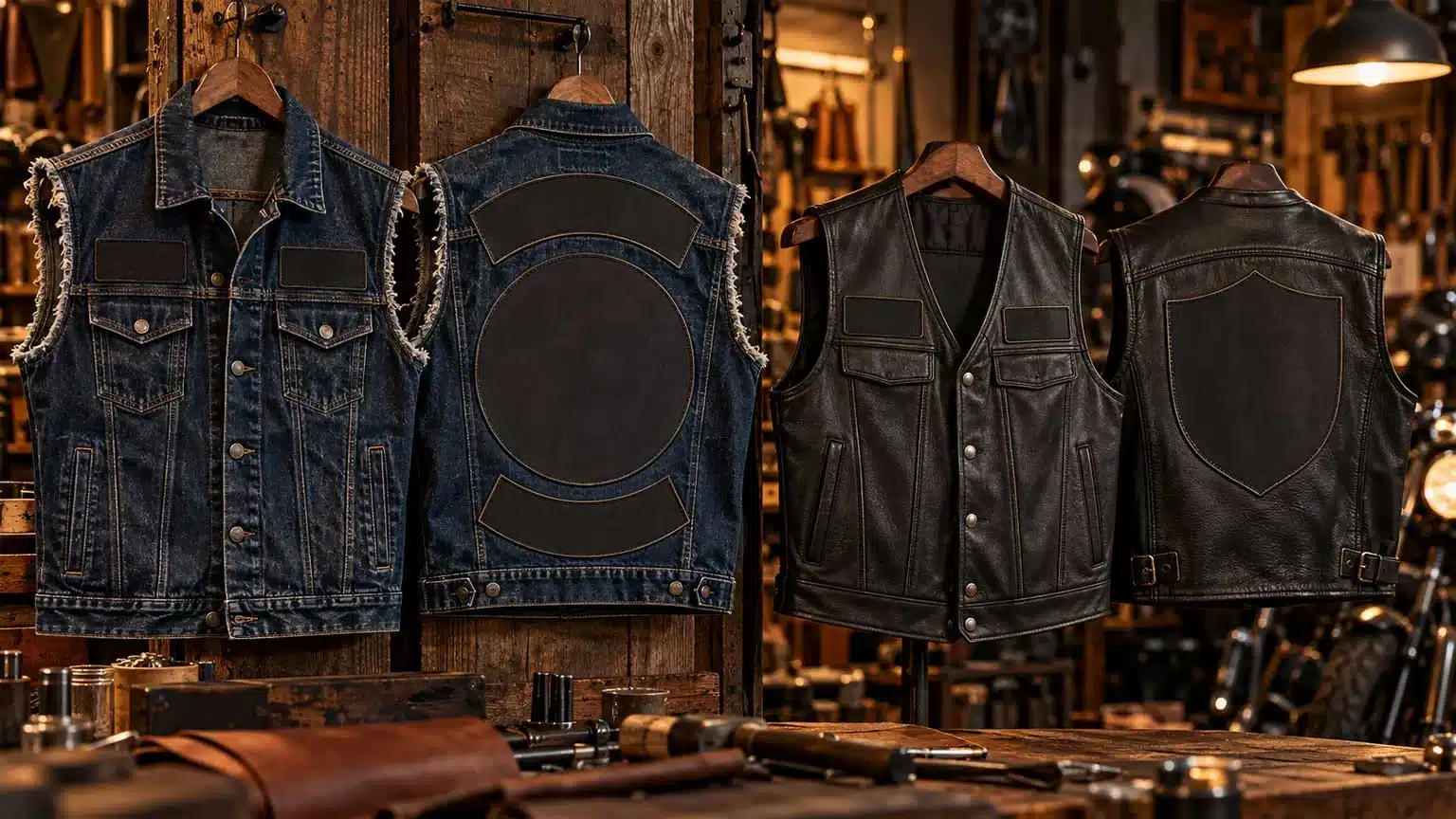
Motorcycle Club Vest Culture: What Colors, Patches, and Rockers Actually Mean
A motorcycle club vest is never just a piece of clothing to the person wearing it. Every element — the colors, the rockers, the patch placement — carries meaning built up over decades of riding culture. For members and prospects, that meaning is something you learn from your club, not from a blog post. This guide covers the general history and structure of vest culture that’s publicly documented and widely understood across the riding community, along with what actually goes into designing and ordering a custom club vest.
Quick Answer
A motorcycle club vest, often called a member’s “colors,” typically centers on a center back patch (the club’s main logo/emblem), a top rocker (the club name, arched above the center patch), and a bottom rocker (the chapter location, arched below), along with additional patches earned or assigned over time that represent rank, milestones, or affiliation. Vest culture and etiquette vary meaningfully between different types of riding groups — traditional one-percenter clubs, family-friendly riding associations, veteran/service organizations, and casual riding crews — so specific rules always come from the club itself, not from a general guide.
A Short History of the Motorcycle Vest
The tradition of wearing a cut-off denim or leather vest displaying club patches dates back to the years following World War II, when returning veterans and other riders formed clubs and adopted military-style patches and insignia as a way to display identity and affiliation. Over the following decades, this evolved into the structured patch system — center patch, rockers, rank patches — that’s still recognized across motorcycle culture today, whether the club is a traditional outlaw-style organization, a Christian motorcycle ministry, a veterans’ riding group, or a casual social riding club.
Denim vests came first, largely because they were practical, affordable, and easy to modify — cutting the sleeves off a denim jacket to create a “cut” is where the term “cut” (still used for a club vest today) comes from. Leather vests became more common later, valued for durability and a more polished, lasting presentation, especially for formal or ceremonial club events.
The Structure of a Club Vest: What Each Element Represents
While specific meanings and rules always belong to the individual club, the general structure below is widely recognized across most motorcycle club and riding association culture:
- Center back patch — the club’s primary emblem or logo, almost always the largest and most prominent patch on the vest.
- Top rocker — an arched patch above the center patch, typically displaying the club’s name.
- Bottom rocker — an arched patch below the center patch, typically displaying the chapter’s city, state, or region.
- Rank and role patches — smaller patches indicating a member’s position (President, Vice President, Road Captain, Sergeant at Arms, and similar roles are common across many types of clubs, not just one-percenter organizations).
- Membership status patches — many clubs use a prospect or probationary period before full membership, often reflected in different patch arrangements during that time.
- Milestone and event patches — patches earned for years of membership, mileage ridden, event participation, or other club-specific achievements.
- MC patch — a small patch, often diamond-shaped, used by some traditional motorcycle clubs to indicate a specific type of club structure; its use and meaning vary significantly and are club-specific.
Important: placement, exact meaning, and rules around any of these elements are set entirely by the individual club — this section describes commonly recognized structure, not a universal rulebook. Never assume what’s appropriate to display without direction from your own club.
Denim vs. Leather Club Vests
Both materials remain common today, and the choice is largely about durability, formality, and personal or club preference rather than one being more “correct.”
Denim vests:
- Lighter and more breathable, often preferred for warm-weather riding or everyday wear.
- Easier and less expensive to patch, re-patch, or modify as membership status or patches change over time.
- Traditional, tied closely to the origin of the “cut” itself.
Leather vests:
- More durable and weather-resistant, holding up better to years of regular wear.
- Often chosen for a club’s formal or ceremonial vest, worn at official events, while denim may be reserved for everyday riding.
- Takes patchwork well and holds stitching securely over a long lifespan.
Many members end up owning both — a denim vest for daily riding and a leather vest for more formal occasions, or vice versa depending on the club’s own conventions.
How Custom Club Vests Are Designed
Ordering a custom vest for a club, chapter, or riding group typically involves a few key decisions beyond material choice:
- Base material and cut. Denim or leather, and a fit that works for the range of body types in the group — custom vest orders are often sized individually per member rather than using standard retail sizing.
- Back panel space. The center back patch is usually the largest element, so the vest’s back panel needs to be sized and positioned to accommodate it along with the top and bottom rockers.
- Front panel layout. Name patches, rank patches, and smaller emblems are typically placed on the front panels, with specific placement usually set by club tradition.
- Closures and pockets. Snap or zip closures, and interior pockets are common practical additions, especially for vests worn on long rides.
- Concealed carry considerations, where legally relevant to the wearer — see below.
A good custom vest maker will work directly with a club or chapter to match their existing patch set and conventions precisely, rather than applying a generic template — consistency across a chapter’s vests matters as much as the individual fit.
Concealed Carry Vests: What to Know
Some riders — separately from any club affiliation — choose a vest specifically designed with a built-in holster pocket for concealed carry. If this applies to you, keep in mind:
- Legal requirements for concealed carry vary significantly by state and country, including permit requirements, where carry is legally permitted, and how a firearm must be concealed. Always confirm your local laws directly rather than assuming a vest’s design alone makes carry legal.
- A dedicated CCW vest typically includes a reinforced interior holster pocket, often ambidextrous, positioned for a fast, natural draw while remaining fully concealed under normal wear.
- Material and construction matter more here than styling — the holster pocket needs secure stitching and a stable fit so the vest doesn’t shift or reveal the firearm during normal movement.
This section is general information, not legal advice — check your local and state laws before carrying concealed in any garment.
Patch Placement Etiquette: General Norms
Because specific rules always belong to the individual club, this section covers only the broad conventions widely recognized across motorcycle vest culture generally:
- The center back patch is treated as the most significant element of the vest and is rarely, if ever, altered without the club’s direction.
- Rockers are almost always positioned directly above and below the center patch, following the arch of the patch itself.
- Smaller patches are typically added over time as they’re earned, rather than all at once — a vest’s patch layout often tells the story of a member’s history with the club.
- Removing or altering another member’s or another club’s patches without authorization is treated seriously across essentially all riding groups — patch placement is not considered a casual styling choice within club culture.
If you’re a prospective or new member, the right answer to almost any specific question about your vest is: ask your chapter directly. General guides like this one describe widely recognized patterns, not your club’s specific rules.
Frequently Asked Questions
What does the bottom rocker on a motorcycle vest mean? The bottom rocker, positioned below the center back patch, typically displays the chapter’s city, state, or region — indicating where that specific chapter of the club is based.
Should I get a denim or leather vest for my club? Both are common and valid choices. Denim is lighter, easier to modify as patches change, and traditional to the original “cut” style. Leather is more durable and often reserved for formal or ceremonial club vests. Many members and chapters use both for different occasions.
Can anyone wear a motorcycle club vest with patches? Patches representing an actual club’s colors are specific to that club’s membership and are not meant to be worn without earning that membership — this is taken seriously across virtually all riding club cultures. Custom vests without club-specific patches (personalized name/logo vests for riding groups, individual riders, or brands) are a separate and unrestricted category.
How is a custom club vest typically ordered? Most custom vest orders start with material and sizing decisions for each member, followed by back-panel layout for the center patch and rockers, and front-panel placement for name and rank patches — usually done directly with a vest maker who can match a chapter’s existing conventions precisely.
Is it legal to wear a concealed carry vest? Wearing the vest itself is legal everywhere; whether you can legally carry a concealed firearm in it depends entirely on your local and state laws, including permitting requirements. Always confirm your specific jurisdiction’s rules rather than assuming a vest’s design makes carry automatically legal.
ZARROE builds custom club and chapter vests to your exact patch layout, sizing, and material preference, including concealed-carry-ready construction where needed. Reach out through our design consultation to start a custom order, or browse our vest collection for ready-made options.
 New Arrivals
 New Arrivals