


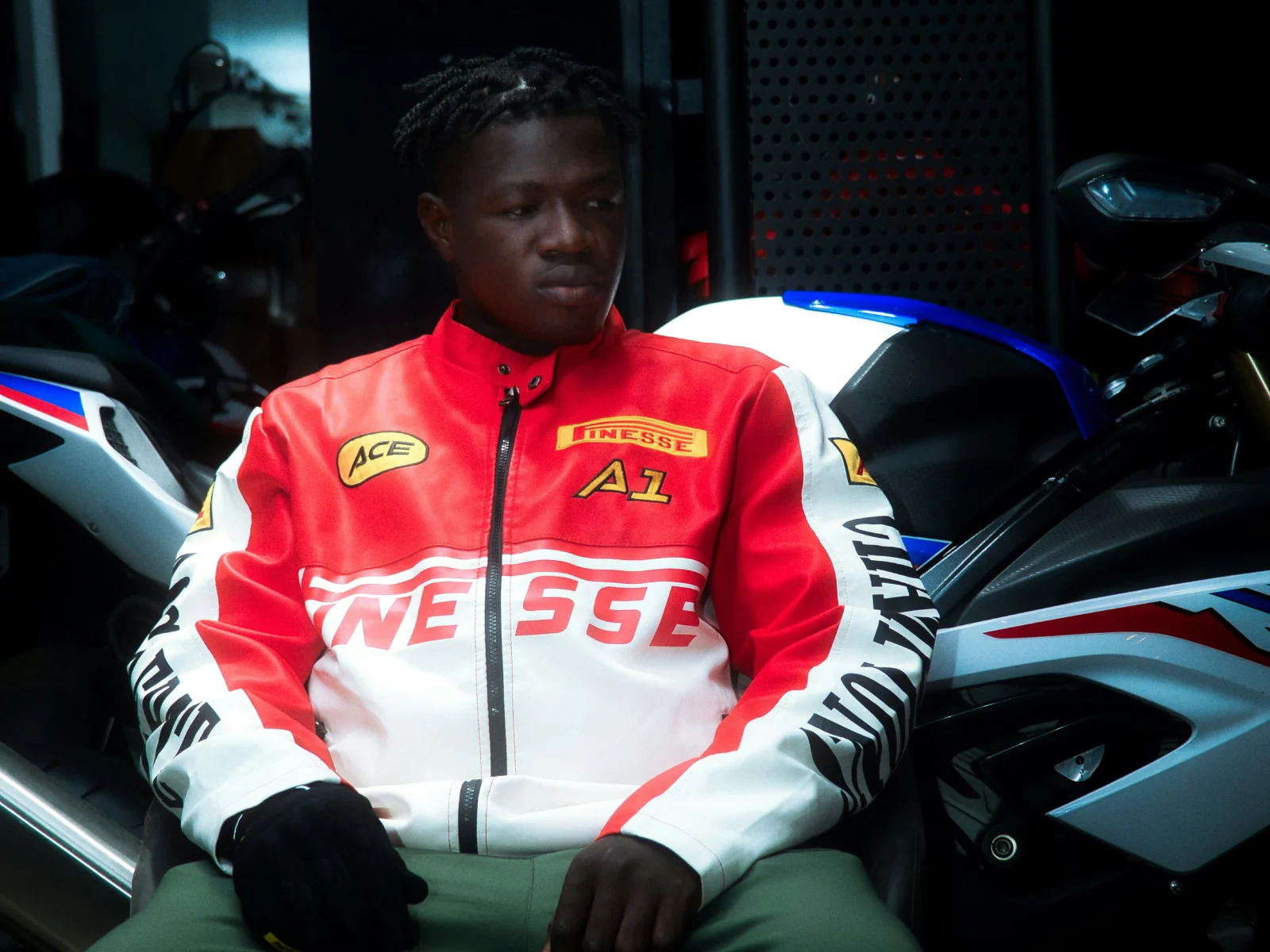
A motorcycle jacket should be long enough to keep your waist and lower back covered in your normal riding position, but not so long that the front bunches against the seat or fuel tank. The correct length is determined on the motorcycle, not while standing upright.
Riding style matters. A sport jacket may be short at the front and extended at the back, while a touring or adventure jacket usually provides more overall coverage. This guide shows how to judge both without relying on one universal measurement.
Quick Answer
When seated with your hands on the controls, the rear hem should continue covering your waistband and lower back. The front should close without riding up, folding into a thick ridge, or pressing into your abdomen. Raise your arms, lean forward, and turn your torso: the jacket should remain secure while allowing free movement.
Why Motorcycle Jackets Are Cut Differently
Street jackets are usually evaluated while the wearer is standing. Motorcycle jackets must work while the arms reach forward and the torso may lean toward the handlebars. Washington State’s motorcycle operator manual explains that many riding jackets extend lower at the back to improve fit in this position.
The front and back therefore do not always need to finish at the same level. A shorter front reduces bunching when seated, while a dropped rear hem helps maintain coverage. This shaped profile is intentional and should not be mistaken for an incorrectly sized jacket.
How Jacket Length Changes by Riding Position
| Riding position | Typical length priority | What to check |
|---|---|---|
| Upright cruiser | Balanced front and rear coverage with room at the waist. | The front should not push upward from the lap or bunch over the belt. |
| Standard or commuter | Moderate front length with a slightly extended rear. | The hem should stay below the waistband during steering and shoulder checks. |
| Sport or cafe racer | Shorter front and a shaped rear for a forward lean. | The jacket should not expose the lower back when reaching for low bars. |
| Touring or adventure | More torso and lower-back coverage for long hours and changing weather. | Extra length must not interfere with the seat, pockets, or hip movement. |
If you are comparing silhouettes, ZARROE’s men’s cafe racer jackets and men’s cruiser jackets illustrate why style and riding posture must be considered together.
How to Test Motorcycle Jacket Length Properly
- Wear the base and midlayers you normally use with the jacket.
- Close every main zipper and waist adjuster before judging the hem.
- Sit on your motorcycle or reproduce its riding posture on a stable chair.
- Reach forward as if holding the grips without lifting your shoulders.
- Check that the rear hem still overlaps the waistband of your riding pants.
- Confirm the front does not create a hard fold against your stomach or tank.
- Turn your head and torso both ways to simulate shoulder checks.
- Stand again and confirm that the jacket does not hang so low that it restricts your hips.
Repeat the test with the jacket’s removable liner installed if you expect to use it. Added bulk can change how the hem sits and may cause a previously comfortable front panel to bunch.
Signs the jacket is too short
- Your shirt or lower back becomes exposed when you reach the bars.
- The rear hem rises above the waistband during normal movement.
- The jacket pulls upward when the sleeves and shoulders are correctly positioned.
- A cold-air gap forms between the jacket and pants.
Signs the jacket is too long
- The front folds into a thick ridge when seated.
- The hem presses into the hips, lap, seat, or fuel tank.
- The jacket rides upward because the seat pushes against it.
- Pockets or waist adjusters become difficult to reach in riding posture.
Coverage and Fit Must Be Judged Together
A longer jacket is not automatically safer or more comfortable. Protective clothing should fully cover the body while fitting snugly enough to remain in place and loosely enough to permit movement, according to Pennsylvania’s motorcycle safety guidance. Length that causes the entire jacket to shift upward can work against that goal.
Also check the relationship between the hem, sleeves, shoulders, and armor. If the body length looks correct but elbow armor moves away from the joint or the shoulders bind, the jacket may have the wrong overall cut. Use the complete motorcycle jacket fit guide to evaluate the whole garment.
Should a Motorcycle Jacket Cover Your Belt?
While standing, many waist-length riding jackets finish around the belt line. What matters more is whether the rear stays below the pants waistband when you sit and reach forward. The hem does not need to cover the thighs like a coat, but it should prevent a persistent gap between the jacket and riding pants.
Body proportions can change the result even when chest size is correct. A taller rider may need a long or tall cut, while a shorter-torso rider may experience bunching in the same nominal size. Always use the product-specific size chart rather than assuming that a larger chest size will solve a length problem. ZARROE’s size guide explains the measurements to compare before ordering.
Does Material Affect the Correct Length?
The basic coverage test is the same for leather and textile jackets, but the feel can differ. A new leather jacket may initially feel firmer at the waist, so excess front length can be especially noticeable when seated. Textile shells may fold more easily, but too much material can still bunch or flap.
Choose the shell based on riding conditions and verified garment features, then assess length in the intended posture. Riders can compare men’s textile motorcycle jackets with the wider men’s motorcycle jacket collection. Women can start with women’s motorcycle jackets, which should be evaluated with the same seated coverage test.
Common Length Mistakes
- Judging only in a mirror: standing posture does not reveal how the rear hem behaves when reaching forward.
- Sizing up only for length: a larger size may make the shoulders, armor, and waist too loose.
- Ignoring riding pants: jacket and pants must overlap as a system, not as separate garments.
- Testing without layers: cold-weather layers can shorten the effective hem and restrict movement.
- Assuming every style should look identical: sport, cruiser, and touring jackets use different front-to-back proportions.
Final Checklist Before You Buy
- The lower back remains covered with both hands reaching forward.
- The front closes smoothly without pressing into your seated torso.
- The hem does not interfere with the seat, tank, belt, or hip movement.
- Shoulder and elbow armor remain correctly positioned.
- The jacket works with your normal pants and seasonal layers.
- You can steer, look behind, and stand on the pegs if your riding style requires it.
Bottom Line
The right motorcycle jacket length is the one that keeps your waist and lower back covered in riding posture without bunching at the front or restricting your hips. Do not choose by standing appearance alone. Test the closed jacket with your normal layers, riding pants, and realistic arm position.
Compare Jackets by Fit and Riding Position
Start with the cut that matches how you sit on the motorcycle, then confirm every measurement against the product size chart.
Explore men’s motorcycle jackets or shop women’s motorcycle jackets.
Technical Sources
Fit and coverage guidance was checked against the Washington State Motorcycle Operator Manual and Pennsylvania motorcycle safety guidance.
 New Arrivals
 New Arrivals