


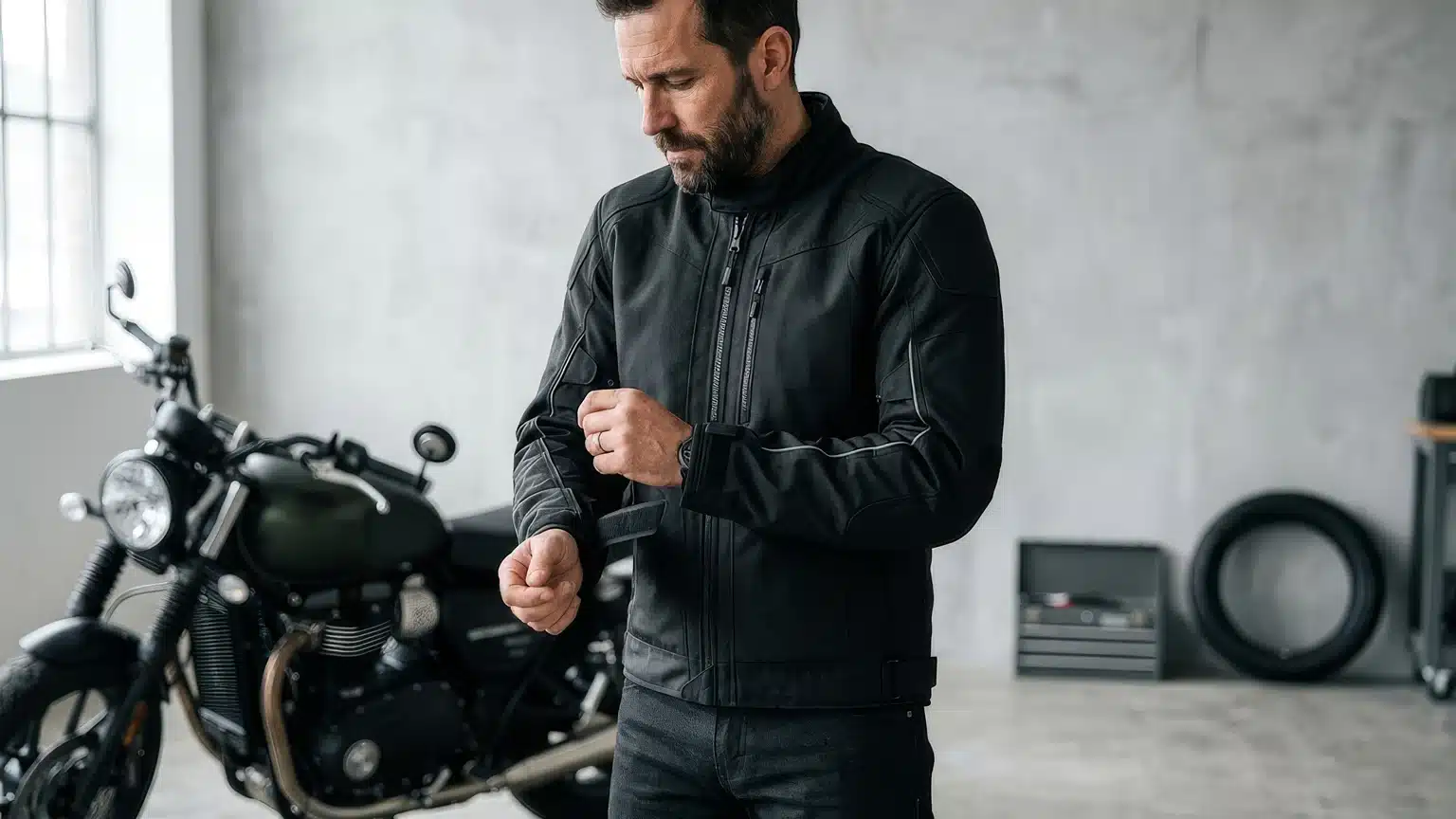
Motorcycle Jacket Safety Features: What to Look for Before You Buy
A motorcycle jacket is more than a shell with armor pockets. Its protection depends on the garment’s materials, construction, impact protectors, coverage and fit working together. Use this checklist to compare jackets by what they actually specify—not by appearance or marketing language.
Quick check: Before buying, verify the exact garment’s test or certification label, which armor is included, where it protects, whether it stays in position in riding posture, and how the jacket covers your wrists and lower back.
Start by comparing the men’s motorcycle jacket collection or women’s motorcycle jacket collection against your riding position and climate. A jacket’s cut or material alone does not establish its protection level; check the specifications for the individual style.
1. Check for a garment-level safety standard
Look for a clear statement about whether the whole garment has been assessed to a motorcycle clothing standard. If a jacket lists EN 17092, check the exact class and read the maker’s product documentation. The EN 17092 series covers protective garments for motorcycle riders and includes different garment classes; the class is more informative than a vague phrase such as “protective jacket.”
Do not confuse a garment standard with the rating of an armor insert. EN 1621 references apply to specific impact protectors, such as limb-joint or back protectors. A rated elbow insert does not, by itself, tell you how the shell, seams or rest of the jacket were assessed. Check which components were tested, the standard and level stated, and whether the information applies to the exact model and version you are buying.
For U.S. shoppers, certifications can be useful comparison details when a product lists them, but the label should be specific and verifiable. If a listing only says “CE armor” or “CE approved,” look for the protector location, standard reference and product documentation before treating that phrase as a complete safety description.
2. Confirm the armor—and what is actually included
Check the jacket’s shoulder and elbow protection first, then see whether it includes a back protector or only has a pocket for one. Product listings may differ: armor may be included, optional, or absent. Do not assume that two jackets in the same category come with the same equipment.
- Confirm which areas have protectors: shoulders, elbows and back.
- Check the protector’s stated standard and level, if provided.
- Make sure each piece is the correct size for the jacket and sits over the intended body area.
- Check that the pocket or retention system holds the protector in place when you reach for the bars.
A back-protector pocket is not the same as a back protector. If you plan to add one, confirm the pocket dimensions and the compatible protector specification. The ZARROE Motorcycle Safety Guide is a useful companion when reviewing protection details across riding gear.
3. Evaluate the shell, reinforcements and seams
Leather, textile and ventilated mesh constructions can all be made differently. Protection depends on the specific material, panel layout, reinforcement and testing—not simply on the material name. On a textile jacket, check which areas use abrasion-resistant fabric and whether the maker identifies reinforcement at likely contact zones. On leather, look for the stated leather type, panel construction and any tested garment rating rather than assuming every leather jacket is built to the same standard.
Inspect the main seams, especially around the shoulders, elbows, armholes and side panels. A clear product description should identify construction or reinforcement details; words such as “premium” or “racing-inspired” are not test results. Hardware matters too: check the main zipper, cuff closures and adjustment points for secure fastening and practical coverage.
If you ride in warm weather, ventilated textile designs can improve airflow, but open mesh does not automatically mean the jacket has the same abrasion resistance, coverage or armor as another textile jacket. Compare the actual construction and labeled protection. Browse men’s textile motorcycle jackets by their listed features, and match them to your route and season.
4. Test the fit in a riding position
Armor only helps as designed when the jacket fits and its protectors stay over the intended areas. Try the jacket with the layers you expect to wear, then sit on your motorcycle or assume a forward-leaning riding position. Reach toward the bars, turn your shoulders and bend your elbows. The jacket should allow those movements without the body or sleeves shifting excessively.
- Shoulder and elbow armor should remain centered when your arms are extended.
- Sleeves should not pull well above the wrists; check them with your gloves on.
- The hem should continue to cover your lower back when you lean forward.
- The jacket should close without pulling hard across the chest or restricting a full breath.
Use the chart for the specific garment instead of choosing by your usual casual size. The ZARROE Size Guide can help you take measurements; the fit notes on the product page should guide the final choice. Fit supports correct coverage, but it is not a safety rating on its own.
5. Look for coverage and secure closures
A jacket should stay closed and maintain useful coverage in the position you ride. Check that wrist adjustments work with your gloves, the collar sits comfortably when fastened, and the waist or hem does not leave an unintended gap when you lean forward. If you want to connect the jacket to riding pants, confirm that the jacket and pants have compatible connection zippers or loops; do not assume they will match.
For touring, a longer cut, adjustable cuffs and practical weather features may suit extended hours in the saddle, but verify them on the exact product. Compare jackets intended for longer-distance use in the touring collection and check the stated fit, closures and included armor before ordering.
6. Treat visibility as part of the safety check
Color and reflective details can help other road users notice you, particularly in low light. NHTSA advises motorcycle riders to wear bright clothing with reflective material and recommends covering the arms and legs with protective clothing. Check where reflective panels sit and whether they are visible from the front, sides and rear in your normal riding posture. A small reflective logo is not the same as a high-visibility design, and visibility features do not replace protective construction.
Read NHTSA’s motorcycle safety guidance for broader U.S. rider recommendations.
7. Choose ventilation and weather features for your real conditions
Vent panels, removable liners and waterproof membranes affect comfort and how often you will reach for a jacket, but they are separate from impact and abrasion ratings. Check whether vents can be opened and closed while stopped, whether the liner is included, and whether the listing says water-resistant or waterproof. Do not infer weather protection from a fabric name or product photo.
For a warm-weather jacket, compare airflow with the garment’s stated armor, reinforcements and coverage. For cooler or wet rides, confirm the liner system and layer space without sizing so loosely that armor moves away from its intended position. The ZARROE Motorcycle Jacket Buying Guide can help you weigh intended use, climate and construction together.
Before you buy: a practical jacket checklist
- I found the product-specific label or documentation and understand what was tested.
- I know which shoulder, elbow and back protectors are included—and which are optional.
- The shell, reinforced areas and seams are described clearly for this exact jacket.
- The protectors remain in place when I lean forward and reach for the handlebars.
- Sleeves, cuffs and hem maintain coverage with my gloves and riding posture.
- Ventilation, liner and water-resistance details match the weather I ride in.
- Reflective or high-visibility features suit the times and roads where I ride.
- I checked the correct size chart and the care instructions for the material.
For leather styles, also follow the garment’s cleaning and storage instructions; see the ZARROE Leather Care Guide. After a crash, inspect the jacket and protectors and follow the manufacturer’s replacement guidance. No jacket can prevent every injury, so choose gear as one part of a complete riding-safety plan.
Motorcycle jacket safety FAQs
Is CE-rated armor enough to make a jacket protective?
No. An impact-protector rating describes that protector, not necessarily the jacket’s shell, seams or overall garment construction. Check both the jacket-level information and the specifications for each included protector.
Does every motorcycle jacket include a back protector?
No. Some jackets include one, some provide a compatible pocket, and some do neither. Read the exact product listing and verify compatibility before buying a separate protector.
Is leather always safer than textile?
Not automatically. Material, construction, coverage, armor, fit and verified testing all matter. Compare complete product specifications rather than choosing by shell material alone.
Does a well-fitted jacket guarantee protection?
No. A good fit helps keep coverage and protectors in their intended positions, but it does not prove that a garment is certified or eliminate crash risk. Verify the construction and product-specific protection information as well.
Standards and safety references
- NHTSA: Motorcycle Safety — U.S. guidance on protective clothing and visibility.
- BSI: EN 17092 motorcycle garment standard — garment-level standard and class information.
- BSI: EN 1621-1 impact protectors — limb-joint protector requirements and test methods.
 New Arrivals
 New Arrivals