


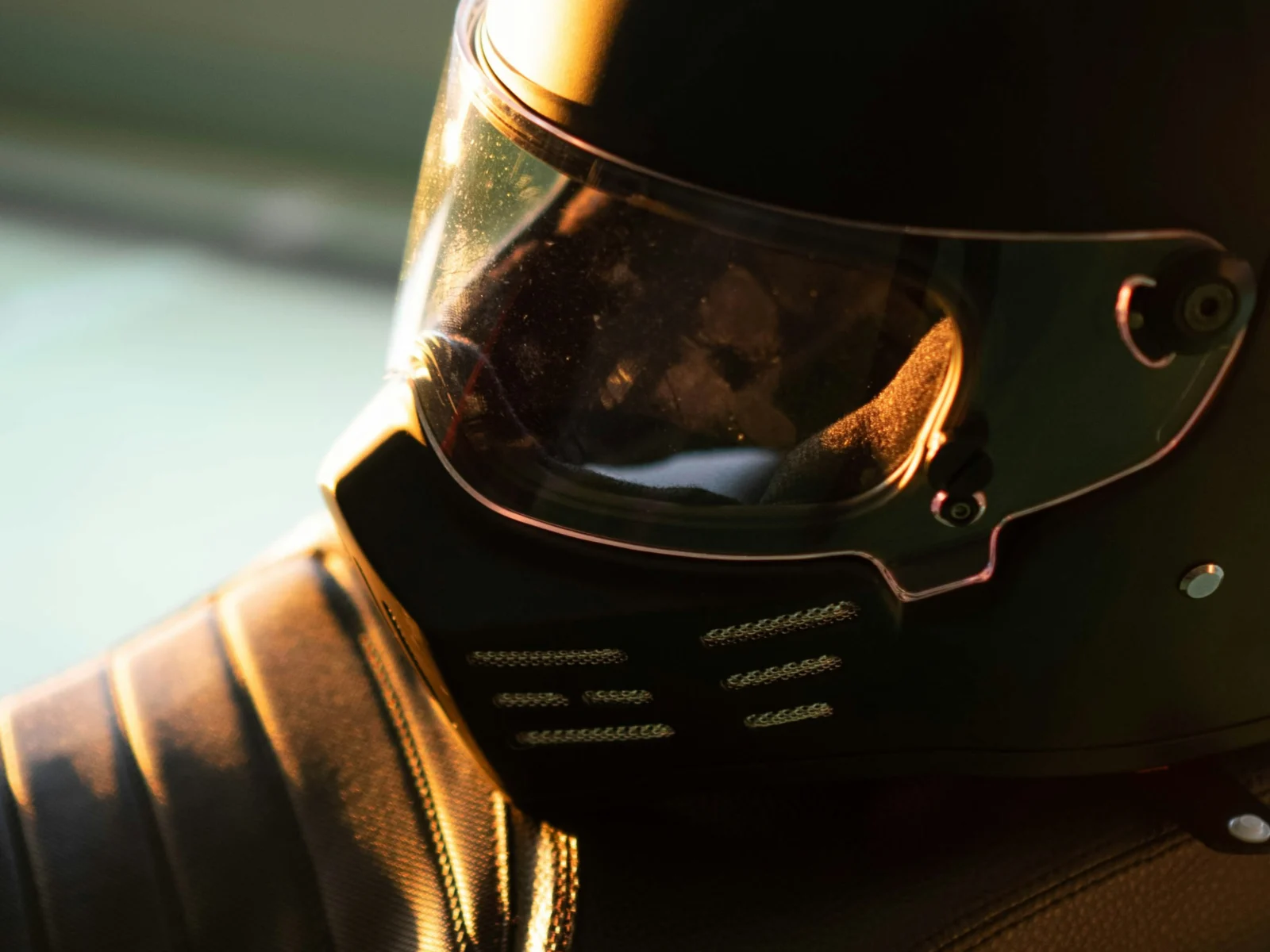
A motorcycle jacket collar should close securely without pressing into your throat, limiting head movement, or interfering with your helmet. It should stay settled at riding speed rather than flap, fold inward, or leave a large open gap at the neck.
Collar fit is easy to overlook in a fitting room because the problem often appears only after you add a helmet, lean toward the handlebars, or ride into wind. Test the complete setup you actually use, including the jacket liner and any thin neck layer.
What a correct collar fit feels like
Close the main zipper and every collar fastener. You should be able to breathe normally, swallow, lower your chin, and turn your head in both directions. The collar may touch the neck, especially on a band or mandarin style, but it should not create a sharp pressure point at the throat or under the jaw.
The Motorcycle Safety Foundation’s protective-gear guide illustrates close-fitting collars and explains that loose collars can flap, irritate the skin, and distract a rider. That makes the useful target secure and comfortable, not simply as tight as possible.
Test the collar with your helmet on
Put on and fasten your helmet before judging the collar. Sit in your riding posture, look left and right as if checking traffic, and tilt your head down toward the instruments. Check the front, sides, and rear of the neckline after every movement.
The collar should not push the helmet upward, catch under its lower edge, force the chin strap out of position, or bunch heavily at the back of the neck. If the jacket feels fine without the helmet but restrictive with it, compare a lower-profile collar or a different cut rather than assuming the whole jacket must be larger.
Do not loosen or alter a helmet retention system to make room for clothing. Follow the helmet manufacturer’s fitting and fastening instructions. The jacket and helmet must work together without changing the prescribed helmet fit.
Match the collar to your riding conditions
Warm-weather riding
A short band collar or low snap-tab design can reduce bulk around the neck. Check that an open snap or tab has a secure parking position and does not strike the helmet or skin. Use the jacket’s intended vents for airflow rather than leaving loose parts uncontrolled.
Cool or windy riding
A close neckline and wind flap can reduce direct airflow. Test the jacket with its removable liner installed if that is how you will wear it. The cold-weather motorcycle jacket guide covers the other features that matter when temperatures fall.
Rain layers
When a rain shell goes over the jacket, close both collars and check the overlap. A stiff stack of collars can press into the throat, while an open channel can direct water inside. MSF’s rain-suit guidance recommends a high, close collar with an adjustable closure, but the fit still needs to permit normal head movement.
How common collar styles change the fit
Band, mandarin, and snap-tab collars
These sit close to the neck and use relatively little material. Check the top edge for pressure and confirm that the tab reaches its fastener without pulling the jacket front sideways. As one current example, the ZARROE AEROXA Prime Motorcycle Jacket lists a mandarin snap-tab riding collar; use its individual measurements and product details when assessing that specific cut.
Classic shirt collars
A fold-down collar creates a more casual profile but adds edges that can lift in airflow. Check whether the points remain controlled when the jacket is fully closed and whether the collar sits cleanly under or beside the helmet.
Double-rider lapels
Lapels are designed to fold back, often with snaps to hold them in place. Fasten every intended snap and test the jacket fully zipped as well as in its normal open-lapel configuration. A loose lapel or belt is a separate fit problem from neck circumference.
Signs the collar is too tight or too loose
Too tight
- The closed collar presses into the throat or jaw.
- You cannot turn your head normally with the helmet on.
- The neckline pulls open the main zipper or lifts the shoulders.
- Adding the intended liner makes breathing or swallowing uncomfortable.
Too loose
- A large gap remains when all fasteners are closed.
- The collar points, tab, or flap move freely in airflow.
- The neckline shifts noticeably when you turn your head.
- Wind enters even though the collar is designed to close at the neck.
A collar problem does not always mean the wrong size. If the chest, shoulders, sleeves, and armor fit correctly but the neckline does not, the jacket’s cut or collar style may simply be incompatible with your neck shape, helmet, or layers. The motorcycle jacket fit guide helps you evaluate the rest of the garment.
Before-you-buy collar checklist
- Wear the base layer and liner you expect to use.
- Zip the jacket and close every collar fastener.
- Breathe, swallow, lower your chin, and turn your head.
- Repeat the test with your helmet correctly fastened.
- Check the rear neckline for bunching under the helmet.
- Secure any tabs, lapels, or loose collar points.
- Test rain or cold-weather layers as a complete system.
- Choose another cut if the neck fails while the rest of the jacket fits.
A well-fitting collar stays controlled, works with the helmet, and allows natural movement. Compare the current men’s motorcycle jackets and women’s motorcycle jackets by collar design as well as material, fit, and intended riding use.
 New Arrivals
 New Arrivals