


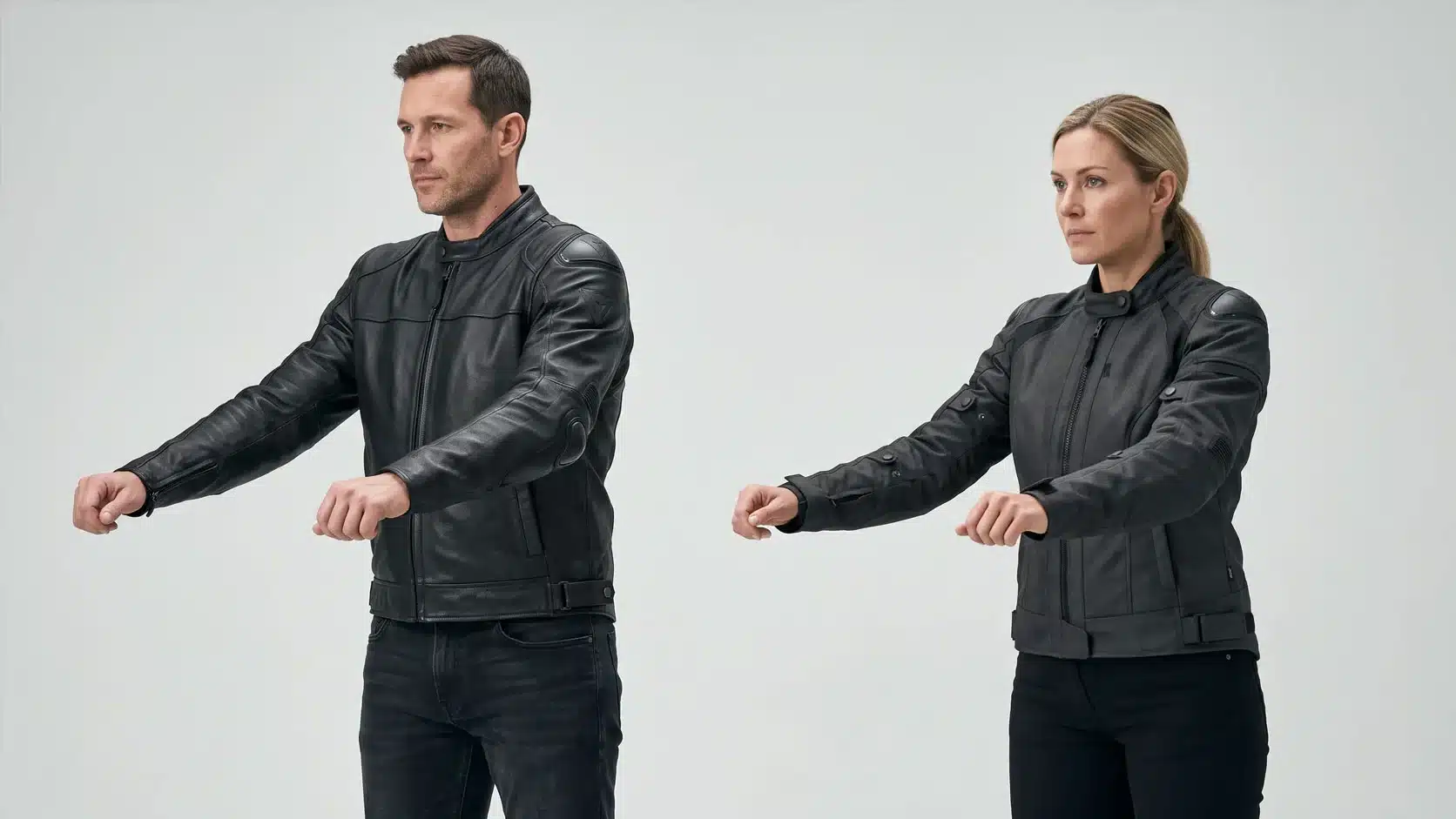
ZARROE Fit Guide · Men & Women
How Should a Motorcycle Jacket Fit?
A motorcycle jacket should feel secure through the shoulders, chest and sleeves, but it should not restrict breathing or control movement. Most importantly, it must fit properly in your riding position—not only while you are standing in front of a mirror.
Use this practical guide to measure your body, check jacket length and sleeve coverage, and choose the correct men’s or women’s size before ordering. The goal is a balanced fit: close enough to keep the jacket and its protective components in position, with enough room for the layers you actually ride in.
The quick fit test
Zip the jacket fully and put on the base layer—and any mid-layer—you expect to wear on the bike. Then sit in your normal riding posture and check these points:
ShouldersThe shoulder seams should sit close to your natural shoulder line. The jacket should not pull hard across your back when you reach forward.
Chest and bustYou should be able to breathe normally and move without the front panel straining, gaping, or pressing painfully.
SleevesReach for the handlebars. The sleeves should not ride far up the forearms or leave the wrists exposed in your riding position.
Hem and backLean forward as you would on your motorcycle. The jacket should continue to cover your lower back without pulling uncomfortably at the shoulders.
One fit check that mattersMove into the position you actually ride in. A jacket can look right while standing but feel restrictive—or shift out of place—once your arms reach forward.
Measure your body before choosing a size
Use a soft measuring tape over a light shirt. Keep it level, snug and untwisted; do not pull it tight enough to compress your body. ZARROE’s size chart is intended to be checked against your body measurements, not compared directly with the width of a jacket laid flat.
| Measurement | How to take it | Why it matters |
|---|---|---|
| Chest / bust | Measure around the fullest part of your chest or bust, under the arms and across the shoulder blades. Keep the tape horizontal and breathe normally. | This is usually the first measurement to check for jacket sizing and front-panel comfort. |
| Waist | Measure around your natural waist—the narrowest point above the hips. Let the tape rest naturally. | Helps you assess whether the jacket closes and adjusts comfortably without excess fabric. |
| Sleeve length | Follow the measurement path stated in the ZARROE chart. For its jacket guide, the tape runs from the center back of the neck, across the shoulder and down the arm to just past the wrist bone. | Helps reduce sleeves that uncover the wrist when you reach forward. |
| Hips | Measure around the fullest part of the hips and seat, with your feet together. | Useful when the jacket hem reaches the hip or when comparing women’s chart measurements. |
Write each measurement down in inches and compare it with the chart for the garment and category you are buying. If you are between sizes, use any fit note on that specific product page rather than assuming one sizing rule applies to every jacket.
How a motorcycle jacket should fit men
For men’s jackets, begin with chest, shoulder and sleeve measurements. Once zipped, the chest should feel close without making a deep breath or forward reach uncomfortable. The shoulder area should stay in place when you extend both arms toward the handlebars.
Check the jacket with the adjustment tabs set comfortably—not cinched as tightly as possible. If the waist feels too loose but the chest and shoulders fit, look for a jacket with usable waist adjustment rather than choosing a size so small that it pulls across the upper body.
Riders with broader shoulders, a muscular chest or longer arms should assess those areas separately. A size that fits the chest but leaves the sleeves short is not a complete fit. Compare all listed measurements and pay attention to regular, tall or other cut notes when the product offers them.
Compare available options in the ZARROE men’s motorcycle jacket collection.
How a motorcycle jacket should fit women
Use the women’s chart shown for the product. ZARROE’s women’s jacket guide includes US sizing alongside bust, sleeve, waist and hip measurements. Do not assume a men’s size converts directly to the same letter size in a women’s cut; sizing and proportions can differ between the charts and between products.
When the jacket is zipped, check that the bust has enough room for a full breath and a forward reach without the front pulling open or pressing uncomfortably. Then check shoulder placement and sleeve length independently. A comfortable bust measurement should not come at the cost of sleeves that expose the wrist or shoulders that slide out of position.
If you plan to wear a layer beneath the jacket, test that layer while checking the fit. A jacket that closes comfortably over a thin shirt may feel restrictive over a thicker riding layer.
See the current options in the ZARROE women’s motorcycle jacket collection.
Signs your jacket may be too tight
- The zipper or front panel strains, waves or pulls open when you sit or reach forward.
- You cannot take a full breath comfortably or move your arms through the riding position.
- The shoulders bind, the back pulls sharply, or the collar presses when you turn your head.
- The sleeves become uncomfortably short or the cuffs cannot work with your gloves.
- Armor or protective inserts, if supplied, press painfully or cannot sit as intended.
Signs your jacket may be too loose
- The body billows, twists or shifts substantially when you move.
- The shoulder or elbow areas move away from their intended positions.
- The sleeves or hem slide around even after using the jacket’s adjustment points.
- There is so much extra room that your protective layers cannot stay properly aligned.
Some jackets are cut for layers or a relaxed fit, so use the intended-fit description for that item. The goal is not to force every jacket into a skin-tight shape; it is a stable fit that allows your riding movement without unnecessary shifting.
Check jacket length and sleeves in riding position
Stand normally, then sit on your motorcycle or mimic your usual riding posture with your arms extended. The sleeves should cover the wrists as you reach the bars. Check the cuff opening with your gloves: depending on the glove and jacket design, the cuff may be worn over or under the glove, but the combination should not leave an exposed gap in your normal riding position.
Lean forward and look for a gap at the lower back. The jacket should not pull so far upward that it exposes the area it is meant to cover. If the product is designed to connect to riding pants, confirm that the connection works with the pants you intend to wear.
Finally, bend your elbows, turn your head and move your torso from side to side. You should be able to operate the controls naturally, without the collar, shoulders or waist restricting you.
Choose the size for the layers you actually wear
Measure as directed by the size chart, then try the jacket over your normal riding base layer. If you regularly ride with a mid-layer, repeat the movement checks while wearing it. The jacket should still close, allow a full reach and keep its sleeves in the right place.
Do not automatically size up “just in case.” Extra room can change how the jacket sits, while a size that is too small can restrict movement. Use the individual product’s fit notes and, when needed, confirm sizing with the brand before ordering.
For more help comparing materials, construction and riding needs, see the ZARROE Motorcycle Jacket Buying Guide.
Fit is important—but it is not a safety rating
A well-fitted jacket can help reduce unwanted movement and keep its components where the design intends them to sit. Fit alone does not prove that a jacket is protective or certified. Armor coverage, materials, seams, testing or certification claims, and intended use vary by product.
Check those details on the exact product page and read the ZARROE Motorcycle Safety Guide before choosing riding gear. Do not infer a protection level from the jacket’s appearance or from a size label.
Motorcycle jacket fit: common questions
Should a motorcycle jacket feel tight?
It should feel secure, not painfully tight. You should be able to breathe normally, reach forward and move your shoulders while the jacket remains stable. A race-oriented cut may feel closer than a touring cut, so consider the product’s stated fit.
Should I size up for a motorcycle jacket?
Not automatically. Measure yourself, follow the specific chart and test the jacket over the layers you will wear. If you fall between sizes, check the product’s own fit note or ask for sizing help instead of applying a blanket rule.
How long should motorcycle jacket sleeves be?
Check sleeve coverage with your arms in riding position. The sleeves should not ride far up the forearms or expose the wrists at the controls. Also make sure the cuffs work with your gloves.
Should a motorcycle jacket cover the lower back?
Check the hem while seated and leaning forward. It should not pull up enough to leave an uncomfortable or unintended gap. Jacket length and riding posture vary by style, so consider the intended use and product description.
Are men’s and women’s motorcycle jacket sizes interchangeable?
No—do not rely on a direct letter-size conversion. Use the chart provided for the specific men’s or women’s product and compare the measurements that matter to your body.
Your final fit checklist
- I measured my body and used the chart for the correct product and category.
- The jacket closes without straining across my chest or bust.
- Shoulders stay in place and I can reach forward naturally.
- Sleeves and cuffs work with my gloves in riding position.
- The hem still covers my lower back when I lean forward.
- I checked the product page for its actual armor, materials and fit details.
A jacket that passes these checks is much more likely to feel right on the road than one chosen by its size label alone.
View the ZARROE Size Guide
Shop Men’s Motorcycle Jackets
Shop Women’s Motorcycle Jackets
 New Arrivals
 New Arrivals