


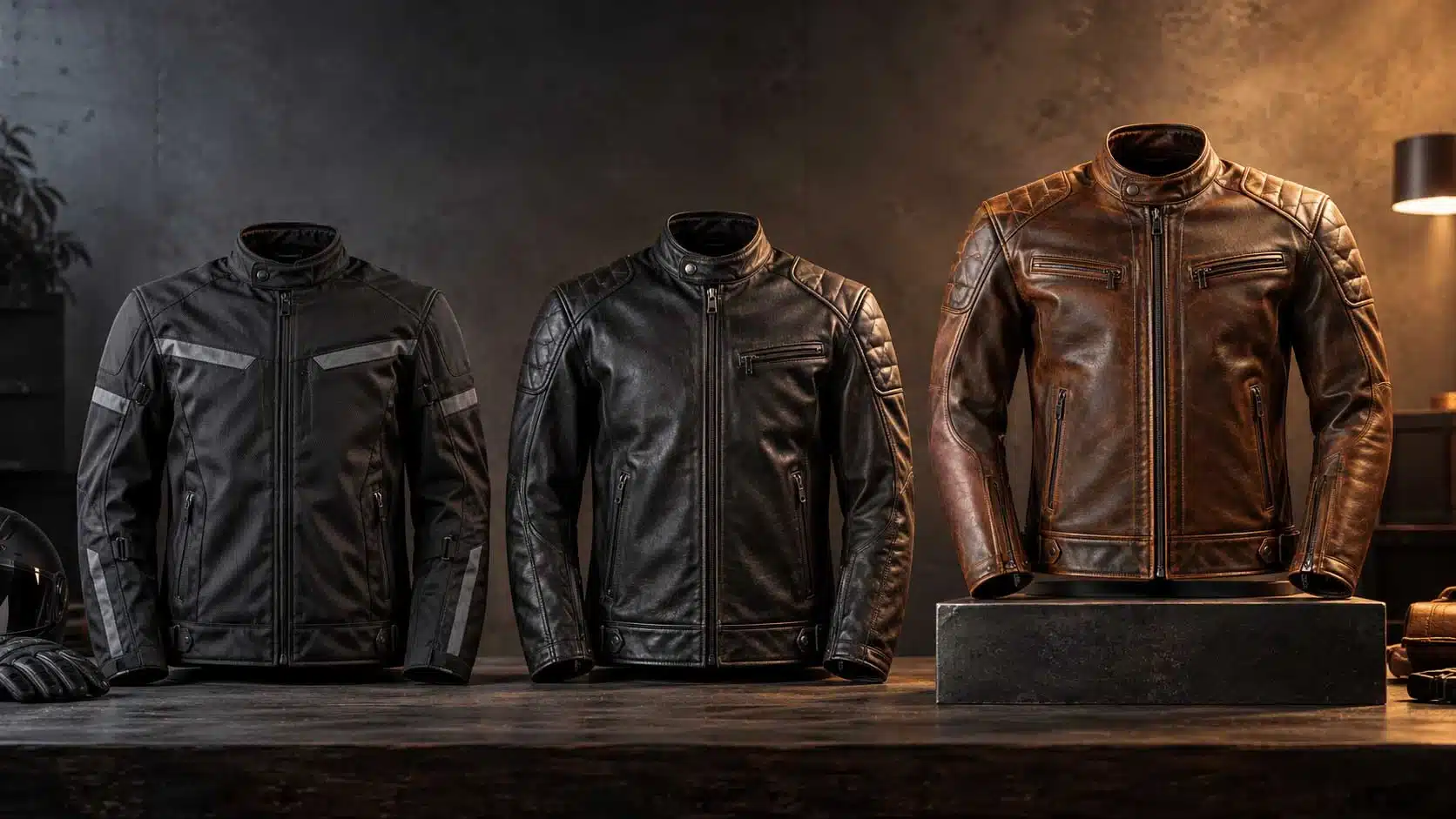
How Much Should a Motorcycle Jacket Cost? A Price and Value Guide
A motorcycle jacket can run anywhere from $80 to well over $800, and the honest question most riders actually want answered is: what am I paying for at each price point, and where does spending more actually matter? This guide breaks down what changes as price increases, so you can spend where it counts and skip paying for features you don’t need.
Quick Answer
Expect to spend $100–$180 for entry-level jackets (basic textile or lower-grade leather, minimal or no included armor), $180–$400 for mid-range jackets (full-grain leather or quality technical textile, CE Level 1–2 armor included, solid construction — where most serious riders land), and $400 and up for premium jackets (top-grain/select leather or advanced technical fabrics, race-derived armor, refined weatherproofing and construction). Price tracks material quality and armor spec far more reliably than it tracks brand name — always check the specific armor rating and material grade rather than assuming a higher price guarantees better protection.
What You’re Actually Paying For
Four factors drive most of the price difference between a $100 jacket and a $500 jacket:
- Material grade. Full-grain and top-grain leather cost significantly more than lower-grade split leather or entry-level textile, and the difference shows up in durability and how the jacket ages.
- Armor quality and coverage. Whether armor is included at all, what CE level it’s rated (Level 1 vs. Level 2), and whether a back protector is included or sold separately all affect price substantially.
- Construction detail. Reinforced stitching, YKK or comparable hardware, articulated (pre-curved) sleeves for riding position, and quality liners all add cost but also add durability and comfort.
- Brand and styling premium. Some of the price at the top end reflects brand reputation and design rather than functional difference — this is the part worth being skeptical of.
Price Tiers, Broken Down
Budget: $80–$180
What you typically get: Entry-level textile or lower-grade split leather, basic or no included armor (often just armor pockets, with protectors sold separately), simpler stitching and hardware.
Reasonable for: Occasional, short-distance riders on a tight budget, or as a starting point while you decide what riding style suits you. Not ideal as your only jacket if you ride frequently or for long distances — the abrasion resistance and armor coverage are the first things cut at this price tier.
What to check carefully: Whether any armor is actually included, and what CE rating it carries if so. A budget jacket with no real armor is closer to a fashion jacket than riding gear.
Mid-Range: $180–$400
What you typically get: Full-grain leather or quality technical textile, CE Level 1–2 armor included at the shoulders and elbows (check whether a back protector is included or separate), reinforced stitching, better hardware, and often a removable liner system on textile jackets.
Reasonable for: Most regular riders. This tier offers the best balance of genuine protection, durability, and price — the point of diminishing returns hasn’t kicked in yet the way it does above $400.
What to check carefully: Specific armor level (Level 2 is worth prioritizing over Level 1 within this range) and whether the back protector is included.
Premium: $400+
What you typically get: Top-grain or select full-grain leather, race-derived CE Level 2 armor throughout, advanced weatherproofing and ventilation systems, refined fit with articulated construction, and often extended warranties.
Reasonable for: High-mileage riders, touring riders who need the jacket to perform across extreme conditions, and anyone wanting a jacket built to last a decade or more with proper care. Above roughly $600–$700, you’re often paying more for brand prestige and refinement than for a meaningful jump in core protection compared to a well-specced $400–$500 jacket.
What to check carefully: Make sure the price increase is buying genuine material and construction upgrades, not just a name — compare the actual specs (armor level, leather grade, warranty) against a strong mid-range option before assuming premium means proportionally better protection.
Where to Spend More, and Where You Can Save
If your budget is limited, prioritize spending in this order:
- Armor (Level 2 where possible). This is the single most important protection factor and the one most worth stretching your budget for.
- Material quality (full-grain leather or reputable technical textile). Determines how well the jacket holds up in a slide and how long it lasts.
- Fit. A well-fitted mid-range jacket protects you better than a poorly-fitted premium one — don’t sacrifice fit to afford a pricier brand.
- Extras (styling, brand name, cosmetic details). The easiest place to save — a jacket doesn’t need to be expensive to look good or to protect you well.
Is a More Expensive Jacket Actually Safer?
Generally yes, up to a point — better materials and higher armor ratings genuinely do improve protection, and that trend holds clearly from budget through mid-range and into the lower end of premium. Above roughly $500–$600, though, additional cost increasingly buys refinement, brand reputation, and styling rather than a proportional increase in actual protection. A well-specced $250–$350 jacket with Level 2 armor and full-grain leather offers most of the real-world protection of a $700 jacket — the extra spend at the top end buys polish, not safety, in most cases.
Frequently Asked Questions
What’s a reasonable price for a good motorcycle jacket? For most riders, $180–$400 represents the best value — full-grain leather or quality textile with CE Level 1–2 armor included, without paying a premium for brand name alone.
Is it worth spending over $500 on a motorcycle jacket? It can be, particularly for high-mileage or touring riders who want top-tier materials, advanced weatherproofing, and refined construction. For most regular riders, though, the jump from $500 to $700+ buys more polish and brand prestige than meaningfully better core protection compared to a well-specced $300–$400 jacket.
Do cheap motorcycle jackets offer any real protection? It depends entirely on the specific jacket — some budget jackets include real CE-rated armor and reasonable abrasion resistance, while others are closer to fashion pieces with no meaningful protection. Always check the specific armor rating and material rather than assuming based on price alone.
What should I prioritize if I’m on a tight budget? Prioritize CE-rated armor (Level 2 if available) and decent material quality over brand name or styling extras. A well-fitted, properly armored mid-range jacket protects you better than an expensive jacket that fits poorly or skips real armor.
Does a more expensive jacket last longer? Generally, yes — higher-grade leather and better construction typically hold up longer with proper care. But a well-maintained mid-range leather jacket can also last a decade or more, so price isn’t the only factor in longevity; maintenance matters just as much.
ZARROE’s motorcycle jacket collection spans budget-friendly to premium full-grain leather, with CE armor specs listed clearly on every product page. Read our fit guide for the full breakdown of what to look for before you buy.
 New Arrivals
 New Arrivals